Antibody detailed product information
| Code No. | K0215-3 | |
| Anti-HLA-E (Human) mAb | ||
| Price | ¥33,000 | |
| Size | 100 µL (1 mg/mL) | |
| Availability (in Japan) | 10 or more
(In Japan at 00:05, Apr 24, 2024 in JST) |
|
| Clonality | Monoclonal | |
| Clone | 4D12 | |
| Isotype (Immunized Animal) |
Mouse IgG1 | |
| Applications | FCM 10 µg/mL (final concentration) IH* reported. (PMID: 20947660) |
|
| Immunogen (Antigen) |
This antibody was established by immunization of HLA-B27 transgenic mice with HLA-E protein. | |
| Reactivity [Gene ID] | Human |
|
| Storage buffer | 1 mg/mL in PBS/50% glycerol, pH 7.2 | |
| Storage temp. | -20°C | |
| Conjugate | Unlabeled | |
| Manufacturer | MBL | |
| Background | HLA-E (human leucocyte antigen-E) is a conserved class I major histocompatibility molecule. It binds to the leader peptide derived from the polymorphic classical MHC molecules HLA-A, HLA-B and HLA-C. This peptide binding stabilizes the HLA-E protein and allows it to migrate to the cell surface. HLA-E then interacts with CD94/NKG2A receptors on natural killer cells. This interaction inhibits natural killer cell-mediated lysis of cells displaying HLA-E. In virally infected or tumor cells, down-regulation of HLA-A, HLA-B and HLA-C production prevents stabilization of HLA-E by the leader peptide. Under these circumstances, HLA-E is degraded before it reaches the cell surface and the cell is then vulnerable to lysis by natural killer cells. | |
| Related products | K0126-3 Anti-HLA-E (Human) mAb K0208-3 Anti-HLA-A24 (Human) mAb K0208-4 Anti-HLA-A24 (Human) mAb-FITC K0208-5 Anti-HLA-A24 (Human) mAb-PE K0208-A48 Anti-HLA-A24 (Human) mAb-Alexa Fluor™ 488 K0209-3 Anti-HLA-A24 (Human) mAb K0209-4 Anti-HLA-A24 (Human) mAb-FITC K0209-5 Anti-HLA-A24 (Human) mAb-PE |
|
| Product category | Research area:Immunology Cell surface antigens | |
| Data | 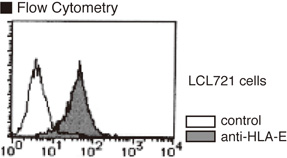 |
|
| Citations | Flow Cytometry
Immunohistochemistry
|
|
- The availability is based on the information in Japan at 00:05, Apr 24, 2024 in JST.
- The special price is shown in red color.
- Please note that products cannot be ordered from this website. To purchase the items listed in this website, please contact us or local distributers.
- Abbreviations for applications:
WB: Western Blotting, IH: Immunohistochemistry, IC: Immunocytochemistry, IP: Immunoprecipitation
FCM: Flow Cytometry, NT: Neutralization, IF: Immunofluorescence, RIP: RNP Immunoprecipitation
ChIP: Chromatin Immunoprecipitation, CoIP: Co-Immunoprecipitation
DB: Dot Blotting, NB: Northern Blotting, RNA FISH: RNA Fluorescence in situ hybridization - For applications and reactivity:
*: The use is reported in a research article (Not tested by MBL). Please check the data sheet for detailed information.
**: The use is reported from the licenser (Under evaluation or not tested by MBL).
- For storage temparature: RT: room temparature
- Please note that products in this website might be changed or discontinued without notification in advance for quality improvement.
 Copyright (C)2015 Medical & Biological Laboratories Co., Ltd. All Rights Reserve